Old vs New Tax Regime FY 2026-27: The Complete Break-Even Guide
Find your exact break-even deduction number to choose between Old and New Tax Regime for FY 2026-27. Compare slabs, rebates, and take-home pay.
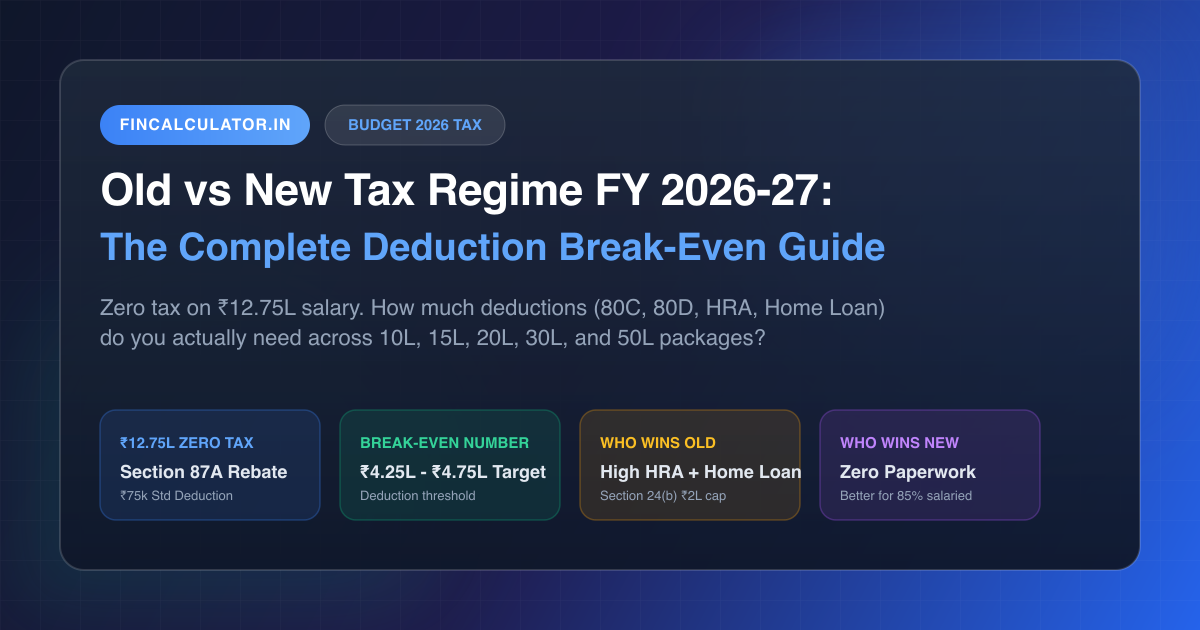
The dilemma every salaried Indian faces in 2026
Every financial year, your company HR asks you to declare your tax regime.
On one side is the Old Tax Regime: higher slab rates, but packed with deductions for house rent (HRA), home loan interest (§24b), life insurance, EPF, and medical premiums (§80D).
On the other side is the New Tax Regime: significantly lower tax slabs, a flat ₹75,000 standard deduction, and zero income tax for gross salaries up to ₹12.75 Lakhs thanks to the Section 87A rebate.
The question is simple: Exactly how much money must you spend on deductions to make the Old Regime beat the New Regime? Here is the exact break-even math.
1. The break-even deduction table across salary tiers
If your total deductions (80C + 80D + HRA + Home Loan Interest) are higher than the break-even number, pick Old Regime. If they are lower, pick New Regime.
Break-Even Deduction Thresholds (FY 2026-27)
| Gross Annual Salary | New Regime Tax | Break-Even Deduction Needed | Practical Advice |
|---|---|---|---|
| ₹10,00,000 (10 LPA) | ₹0 (100% Rebated) | ₹5,00,000+ | New Regime is 100% Better (Zero Tax) |
| ₹12,75,000 (12.75 LPA) | ₹0 (100% Rebated) | ₹7,25,000+ | New Regime is 100% Better (Zero Tax) |
| ₹15,00,000 (15 LPA) | ₹97,500 | ₹5,44,000 | Old Regime wins only with high HRA + 80C |
| ₹20,00,000 (20 LPA) | ₹1,92,400 | ₹7,09,000 | Need Home Loan + HRA + 80C to win Old |
| ₹30,00,000 (30 LPA) | ₹4,75,800 | ₹8,00,000 | New Regime wins for most techies |
| ₹50,00,000 (50 LPA) | ₹10,99,800 | ₹8,00,000 | New Regime offers clean, paperless filing |
2. Calculate your personal break-even number
Use the interactive calculator below to input your exact CTC and see the deduction target needed for your salary:
Interactive Tax Regime Break-Even Calculator
Find out if your actual investments and rent receipts beat the New Tax Regime.
New Tax Regime is Better!
Your planned deductions (₹2,25,000) are less than the break-even threshold (₹5,44,000). Switching to New Regime saves you ₹89,700 in tax with zero investment lock-ins!
Income & Planned Deductions
Old Regime Deductions You Plan to Claim:
Break-Even Deduction Matrix across Indian Salary Tiers (FY 2026-27)
| Annual CTC Package | New Regime Tax (₹) | Break-Even Deductions Required (₹) | Old Regime Feasibility |
|---|---|---|---|
| ₹7.5 LPA | ₹0 | ₹2.00 L | Achievable (with HRA + 80C) |
| ₹10.0 LPA | ₹0 | ₹4.50 L | Achievable (with HRA + 80C) |
| ₹12.0 LPA | ₹0 | ₹6.50 L | Nearly Impossible in Old |
| ₹15.0 LPA | ₹97,500 | ₹5.44 L | Nearly Impossible in Old |
| ₹20.0 LPA | ₹1.92 L | ₹7.09 L | Nearly Impossible in Old |
| ₹25.0 LPA | ₹3.20 L | ₹8.00 L | Nearly Impossible in Old |
| ₹30.0 LPA | ₹4.76 L | ₹8.00 L | Nearly Impossible in Old |
| ₹50.0 LPA | ₹11.00 L | ₹8.00 L | Nearly Impossible in Old |
Break-Even Deduction Threshold Curve
Visualizing the rising deduction barrier required in Old Regime across income levels.
Old vs New Tax Regime Break-Even Point 2026: The Deduction Threshold Chart
Exact deduction break-even thresholds from ₹7.5L to ₹50L CTC, Section 87A rebate rules, and why 90%+ taxpayers benefit from New Regime.
How to Use Break-Even Analysis to Choose Your Tax Regime
1. The ₹12.75 Lakh Zero-Tax Threshold
Under FY 2026-27 New Tax Regime, any salary up to ₹12.75 Lakhs (₹12L income + ₹75k standard deduction) pays ₹0 income tax thanks to the enhanced Section 87A rebate.
2. The Investment Lock-In Trap
In the Old Regime, to save ₹40,000 in tax, you often have to lock away ₹1.5 Lakhs in PPF/ELSS for 3 to 15 years. The New Regime gives you the same tax savings with 100% liquid cash in hand.
Frequently Asked Questions (FAQs)
Authoritative References & Official Portals
Regime breakeven, with your numbers
The new regime has lower rates but almost no deductions. The old regime only wins once your deductions are large enough to offset that rate gap. Below the breakeven figure the new regime costs less; above it the old regime does. Compare it against deductions you genuinely claim, not ones you might.
Want to explore more scenarios?
Try Full Calculator3. Who wins under which regime in 2026?
When the New Tax Regime is Better
- Salaries up to ₹12.75 Lakhs: You pay ₹0 tax automatically without locking any cash into lock-in schemes.
- Young professionals renting cheap: If you live with parents or pay modest rent, you cannot claim enough HRA to beat the ₹4L+ break-even threshold.
- No home loan: Without ₹2 Lakhs of home loan interest deduction under Section 24(b), reaching ₹4.25L deductions is very difficult.
- Zero paperwork: No need to submit rent receipts, landlord PAN, or insurance premium proofs to HR every January.
When the Old Tax Regime Still Wins
- Paying high metro rent: If you claim ₹2.5L+ in HRA exemptions plus ₹1.5L under 80C, your total deductions cross ₹4L easily.
- Active home loan borrowers: Claiming ₹2 Lakhs under Section 24(b) plus ₹1.5L under 80C plus ₹50k under 80D puts your deductions at ₹4.5L+, making Old Regime save you ₹30,000 to ₹60,000 extra.
5-Step Checklist to Pick Your Regime in 5 Minutes
1. Check if Gross CTC is under ₹12.75 Lakhs
If your gross salary is ₹12.75L or less, choose New Tax Regime immediately. Your tax liability is exactly ₹0.
2. Add up your real guaranteed deductions
Calculate your actual Section 80C (EPF + ELSS), Section 80D (Mediclaim), and Section 24(b) Home Loan Interest.
3. Calculate your eligible HRA exemption
Check how much HRA you can legitimately claim based on rent receipts and metro city rules.
4. Compare total deductions against your breakeven threshold
At ₹15L the threshold is about ₹5.44 Lakhs, at ₹20L about ₹7.09 Lakhs, and from ₹30L upward ₹8 Lakhs. Clear it and the Old Regime saves tax; below it the New Regime wins.
5. Inform HR or declare during July ITR filing
Salaried employees can switch regimes when filing their actual ITR in July, even if they declared differently to HR.
Authoritative references
- Income Tax Department, Old vs New Regime Slabs, Section 87A Rebate and Section 115BAC Deductions: incometax.gov.in
- Income Tax Department, FAQs on New vs Old Tax Regime (HRA, Section 24(b) and switching rules): incometax.gov.in
- Union Budget 2025-26 Speech, Nil Tax up to ₹12 Lakh (₹12.75 Lakh for Salaried) and Revised New Regime Slabs: indiabudget.gov.in
- Finance Act, 2025, Section 87A Rebate Raised to ₹60,000 for Income up to ₹12 Lakh: egazette.gov.in
Frequently Asked Questions (FAQs)
What is the break-even deduction point between Old and New Tax Regime in FY 2026-27?
For a ₹15 Lakh salary, your total eligible deductions under the Old Regime (80C, 80D, HRA, home loan interest) must exceed ₹5,44,000 for the Old Regime to result in lower tax than the New Regime. For a ₹20 Lakh salary, deductions must cross ₹7,09,000. These thresholds are high because the New Regime already gives a ₹75,000 standard deduction and lower slab rates.
Is salary up to ₹12.75 Lakhs zero tax in New Regime?
Yes. Under the New Tax Regime for FY 2026-27, a gross salary of ₹12,75,000 attracts zero income tax. The ₹75,000 standard deduction brings taxable income to ₹12,00,000, which gets fully rebated under Section 87A (maximum ₹60,000 rebate).
Can I switch between Old and New Tax Regime every year?
Salaried employees with no business or professional income can switch between the Old and New Tax Regimes every year at the time of filing their ITR. Individuals with business or freelance income (ITR-3/ITR-4) can only switch once in a lifetime.
Do I get HRA and Section 80C benefits in the New Tax Regime?
No. The New Tax Regime does not permit deductions for HRA, Section 80C (PPF, ELSS, LIC), Section 80D (Health Insurance), or Section 24(b) home loan interest. It provides lower baseline tax slab rates and a flat ₹75,000 standard deduction instead.
Relevant Financial Calculators
Put these concepts into practice using our free, instant financial calculators: