Gratuity Calculation Formula: 15/26 Rule Explained with 5 Examples
Understand how Indian employers calculate gratuity. Learn the 15/26 formula, the 240 day court rule, and the 20 lakh tax free limit.
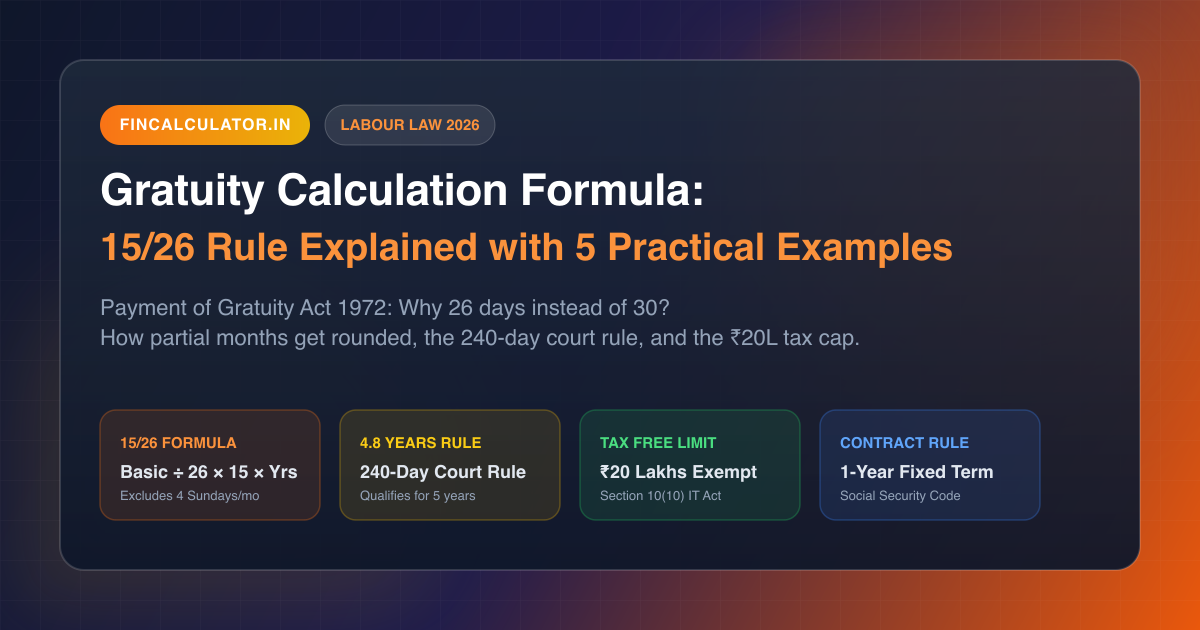
How gratuity actually gets calculated in India
When you resign from a company after several years of service, one of the largest single sums credited to your account is your gratuity.
Gratuity is a statutory reward governed by the Payment of Gratuity Act 1972. It is paid by employers as gratitude for continuous service.
The calculation formula looks simple on paper, but details like Sunday exclusions, month rounding, and tax caps confuse most employees. Here is the exact math explained in plain English.
1. The 15/26 formula: why 26 days instead of 30?
For companies covered under the Gratuity Act (almost every private company with 10 or more staff), the law uses this formula:
The Statutory Gratuity Formula
Gratuity = (15 × Last Drawn Basic Salary × Completed Years of Service) ÷ 26
Why 26? The law treats a working month as 26 days, excluding 4 weekly off days (Sundays). Dividing your monthly basic by 26 gives your true one-day wage. You get 15 days of wages for every completed year of service.
Quick Tip
2. How partial months get rounded
You rarely resign on your exact employment anniversary. The law uses a fair rounding system:
- If you work more than 6 months in your final year, it rounds up to the next full year. For example, 7 years and 7 months is counted as 8 years.
- If you work 6 months or less, that fractional year is ignored. For example, 7 years and 4 months is counted as 7 years.
The 4 Year and 240 Day Court Rule
A common question is whether resigning at 4.5 or 4.8 years earns gratuity. This is genuinely unsettled. The Madras High Court in 2011 and the Kerala High Court in 2015 read the deeming provision in Section 2A as applying to the fifth year, so 4 full years plus 240 working days in the fifth year counts as five — but there is no Supreme Court ruling, and the Andhra Pradesh High Court has refused gratuity even at 4 years 11 months. Each High Court decision binds only its own jurisdiction. Our calculator therefore requires a full five years before showing any entitlement, which is the safe assumption. If you fall in that window and your employer refuses, the claim is arguable, not automatic.
3. Five practical examples: from junior to senior
Let us look at five real scenarios to see how tenure and salary affect the final payout:
Gratuity Payout Examples Across Different Tenures
| Employee Profile | Last Basic | Tenure | Years Counted | Gratuity Payout | Tax Status |
|---|---|---|---|---|---|
| Junior Engineer (Resigning before 5 years) | ₹35,000 | 4 yrs 8 mos | Disputed | ₹0 (₹1,00,962 if 4y240d is accepted) | Tax free if paid |
| Mid Level Manager (7 year tenure) | ₹65,000 | 7 yrs 7 mos | 8 Years | ₹3,00,000 | 100% Tax Free |
| Senior Lead (12 year tenure) | ₹1,10,000 | 12 yrs 2 mos | 12 Years | ₹7,61,538 | 100% Tax Free |
| VP / Director (20 year tenure) | ₹2,20,000 | 19 yrs 9 mos | 20 Years | ₹25,38,462 | ₹20L Tax Free, ₹5.38L Taxed |
| Fixed Term Contract Staff (2 years) | ₹40,000 | 2 yrs 0 mos | 2 Years | ₹46,154 | 100% Tax Free (1-Yr Rule) |
4. Calculate your exact gratuity payout
Use the interactive calculator below to input your exact monthly basic pay and service duration:
Interactive Gratuity Calculator 2026
Calculate your exact payout, tax-free exemption status, and 5-year eligibility timeline.
15/26 formula applies. ≥6 months in final year rounds up to +1 year. Mandatory 5 yrs service.
Enter Basic Pay + Dearness Allowance (DA) from payslip. Exclude HRA, Special Allowance & Bonus.
₹2.88 L
Eligible! Based on 10 years counted.
Gratuity Accumulation Trajectory
Visual growth curve of your gratuity benefit over service tenure.
Year-by-Year Gratuity Payout Projection
See how your gratuity entitlement grows from Year 1 to 30.
| Service Tenure | Applied Formula | Gratuity Payable | Tax-Free Limit | Taxable Amount |
|---|---|---|---|---|
| 1 Year | 15/26 × Basic × Yrs | ₹0 (Ineligible) | ₹0 | ₹0 |
| 2 Years | 15/26 × Basic × Yrs | ₹0 (Ineligible) | ₹0 | ₹0 |
| 3 Years | 15/26 × Basic × Yrs | ₹0 (Ineligible) | ₹0 | ₹0 |
| 4 Years | 15/26 × Basic × Yrs | ₹0 (Ineligible) | ₹0 | ₹0 |
| 5 Years | 15/26 × Basic × Yrs | ₹1.44 L | ₹1.44 L | ₹0 |
| 6 Years | 15/26 × Basic × Yrs | ₹1.73 L | ₹1.73 L | ₹0 |
| 7 Years | 15/26 × Basic × Yrs | ₹2.02 L | ₹2.02 L | ₹0 |
| 8 Years | 15/26 × Basic × Yrs | ₹2.31 L | ₹2.31 L | ₹0 |
| 9 Years | 15/26 × Basic × Yrs | ₹2.60 L | ₹2.60 L | ₹0 |
| 10 YearsYour Input | 15/26 × Basic × Yrs | ₹2.88 L | ₹2.88 L | ₹0 |
| 11 Years | 15/26 × Basic × Yrs | ₹3.17 L | ₹3.17 L | ₹0 |
| 12 Years | 15/26 × Basic × Yrs | ₹3.46 L | ₹3.46 L | ₹0 |
| 13 Years | 15/26 × Basic × Yrs | ₹3.75 L | ₹3.75 L | ₹0 |
| 14 Years | 15/26 × Basic × Yrs | ₹4.04 L | ₹4.04 L | ₹0 |
| 15 Years | 15/26 × Basic × Yrs | ₹4.33 L | ₹4.33 L | ₹0 |
| 16 Years | 15/26 × Basic × Yrs | ₹4.62 L | ₹4.62 L | ₹0 |
| 17 Years | 15/26 × Basic × Yrs | ₹4.90 L | ₹4.90 L | ₹0 |
| 18 Years | 15/26 × Basic × Yrs | ₹5.19 L | ₹5.19 L | ₹0 |
| 19 Years | 15/26 × Basic × Yrs | ₹5.48 L | ₹5.48 L | ₹0 |
| 20 Years | 15/26 × Basic × Yrs | ₹5.77 L | ₹5.77 L | ₹0 |
Gratuity Calculation Formula (15/26 Rule) & 5-Year Exemption Guide
Why 26 is used instead of 30, the 4-year 240-day court precedent, contract employee rules, and claiming the ₹20 Lakh tax exemption.
Complete Guide to Gratuity Rules in India (FY 2025–26 & FY 2026–27)
Gratuity is a statutory monetary benefit provided by an employer to an employee in recognition of long-term continuous service. It is governed primarily by the Code on Social Security, 2020, which replaced the Code on Social Security, 2020 (formerly the Payment of Gratuity Act, 1972) on 21 November 2025.
Whether you are planning a resignation, job change, or retirement, understanding gratuity calculation formulas, 6-month rounding rules, and tax exemption thresholds ensures you claim your exact statutory dues.
1. The 15/26 Act Formula (Covered)
Applies to private & PSU organizations with 10 or more employees.
Why 26? The law assumes 26 working days in a month (excluding 4 Sundays), crediting 15 days of wages per year served.
2. The 15/30 Rule (Not Covered)
Applies when employer is not covered under the Gratuity Act (governed by IT Act §10(10)(iii)).
Denominator uses 30 calendar days. Only full completed years count (partial months dropped).
Key Legal Updates & Special Provisions
- New 1-Year Rule for Fixed-Term Employees: Under the Code on Social Security 2020, fixed-term contractual staff qualify for gratuity after completing just 1 year of continuous service (pro-rata).
- The 4 Years 240 Days Court Precedent: Under Section 2A and High Court judgments (e.g. Madras HC in Mettur Beardsell Ltd), working 4 years and 240 days in the 5th year legally satisfies the 5-year eligibility threshold.
- New Wage Code 50% Rule: Under the Code on Wages, Basic Salary + DA must constitute at least 50% of your total CTC. If allowances exceed 50%, the excess is added back to Basic for gratuity computation.
- Lifetime ₹20 Lakh Tax Exemption Cap: For private employees, up to ₹20,00,000 of gratuity is tax-exempt over an individual's entire professional career under §10(10). Central and State Govt staff enjoy 100% tax-free status.
Authoritative References & Government Acts
Want to explore more scenarios?
Try Full Calculator5. Tax rules under Section 10(10) of the Income Tax Act
For non government employees, gratuity is tax free up to the least of these three amounts:
- The statutory limit of ₹20,00,000 (lifetime cap across all employers).
- The actual gratuity amount received.
- The formula calculated gratuity (15/26 × Basic × Years).
Government employees (Central, State, Defense) enjoy 100% tax free gratuity with no upper limit.
Authoritative references
- Ministry of Labour and Employment, Payment of Gratuity Act 1972: labour.gov.in
- Income Tax Department, Section 10(10) Gratuity Exemption Rules: incometaxindia.gov.in
- Code on Social Security 2020, Fixed Term Employee Provisions: egazette.gov.in
Frequently Asked Questions (FAQs)
Is gratuity calculated on basic salary or total CTC?
Gratuity is calculated strictly on your last drawn Basic Salary plus Dearness Allowance (DA). Allowances like HRA, special allowance, and performance bonus are not included in the calculation.
Are you eligible for gratuity if you resign after 4 years and 8 months?
It is disputed, and the answer depends on where you are. The Madras High Court (2011) and the Kerala High Court (2015) have held that 4 years plus 240 days in the fifth year satisfies Section 2A. The Andhra Pradesh High Court has taken the opposite view, holding even 4 years 11 months ineligible. There is no Supreme Court ruling, so a High Court decision binds only its own jurisdiction, and many employers pay nothing before a full 5 years. Treat it as a claim you may have to pursue, not an entitlement you can count on.
What is the maximum tax free gratuity limit in India?
For private sector employees, gratuity up to ₹20 Lakhs is completely tax free under Section 10(10) of the Income Tax Act. Any amount received above ₹20 Lakhs is added to your income and taxed at your regular slab rates.
What is the 1 year gratuity rule for fixed term contract workers?
Under the Code on Social Security 2020, fixed term contractual employees are entitled to gratuity on a pro rata basis after completing just 1 year of service, rather than the 5 year requirement for permanent staff.
Relevant Financial Calculators
Put these concepts into practice using our free, instant financial calculators: