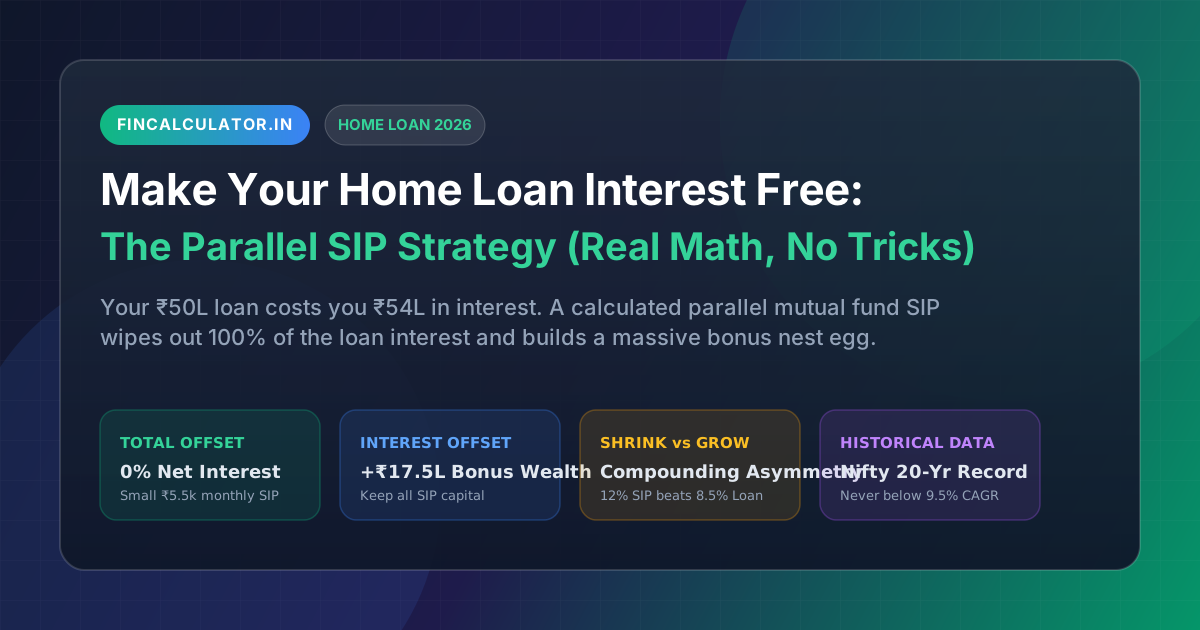
You borrow ₹50 lakh from a bank at the current 8.45 percent EBLR linked rate for 20 years. The bank tells you the EMI is ₹43,233 a month. Sounds doable. You sign.
What the bank does not put on a billboard is the total interest. By the end of year 20, you will have paid the bank roughly ₹53.7 lakh in interest alone. That is more than the loan itself. Your ₹50 lakh house actually cost you ₹1.03 crore.
Most personal finance content stops here. The takeaway is supposed to be either rent forever or accept that owning a home is just expensive. There is a third option nobody talks about, and the math is unambiguous.
Run a small SIP alongside your EMI. By year 20, the SIP corpus pays back every rupee of interest you handed the bank. In the aggressive version of the strategy, you also keep the entire SIP principal as bonus wealth. You own the house. You own the corpus. The interest cost vanishes.
Why the math works (and why banks do not advertise it)
After the RBI cut the repo rate by 100 basis points across 2025 (from 6.5 to 5.5 percent), Indian home loan rates in FY 2025-26 sit between 7.85 and 9.10 percent for salaried prime borrowers (SBI, HDFC, ICICI EBLR linked schemes, March 2026). AMFI data through January 2026 shows large cap equity mutual funds returning 13.6 percent CAGR over rolling 15 year periods. Flexi cap funds clocked 14.3 percent. Even with the recent RBI cuts narrowing the gap, the equity return premium over home loan rates still sits around 4 to 6 percentage points.
That gap is the entire game. Three to five points may sound small. Compounded over 20 years on a growing SIP balance, it crushes the absolute interest cost on a fixed home loan.
The two compounding asymmetries that do the work
Two things make this strategy lopsided in your favor.
First, your loan interest compounds on a shrinking balance. Every EMI you pay chips away at the principal. The bank charges 8.5 percent, but on a base that gets smaller every month.
Second, your SIP returns compound on a growing balance. Every contribution adds to the base earning returns next month. The corpus snowballs.
Shrinking base versus growing base. That is why a 12 percent SIP outpaces an 8.5 percent loan even though the headline rates look close.
Quick Tip
This is parallel investing, not refinancing. You still pay the full EMI to the bank every month. The SIP is a separate, automated commitment funded by the rest of your monthly cash flow.
Two ways to run it. Pick your version.
You have two flavors of this strategy. Both wipe out the loan interest. They differ in how much you commit each month and how much you walk away with.
Total Offset (the conservative path)
You invest a smaller monthly amount. The full SIP corpus at year 20 (your principal plus returns) equals the total loan interest. Net cost of the loan comes down to roughly the principal you borrowed. You break even on interest.
Interest Offset (the aggressive path)
You invest a slightly larger monthly amount. Now only the SIP returns need to cover the loan interest. Your invested principal stays untouched. You walk away with the house plus a cash bonus equal to everything you ever put into the SIP.
₹50L loan at 8.5 percent over 20 years, SIP at 12 percent
Metric
Total Offset
Interest Offset (Aggressive)
Required monthly SIP
₹5,500
₹7,300
Total SIP invested over 20 years
₹13.2 lakh
₹17.5 lakh
SIP corpus at year 20
~₹54 lakh
~₹72 lakh
How interest gets covered
Full corpus consumed
Returns alone cover it
Bonus wealth at year 20
₹0
₹17.5 lakh
Combined monthly outflow (EMI plus SIP)
₹48,891
₹50,691
Pick aggressive if your cash flow allows it
Look at the bottom row. The combined monthly outflow differs by ₹1,800. The year 20 outcome differs by ₹17.5 lakh. That is a 1,000x return on the extra commitment.
If you can absorb that small extra hit, take it. You finish 20 years with the house, the bank paid in full, and a ₹17.5 lakh nest egg you can deploy for retirement, your kid's college, or anything else.
Run your own numbers
Plug in your loan, rate, tenure, and expected SIP return. Toggle between Total Offset and Interest Offset to compare. The calculator shows the year by year corpus growth and stacks it against the loan's interest burden.
Interest Free Home Loan Calculator
Switch between Total Offset and Interest Offset modes to see both versions of the strategy.
Rohit (33, product manager at a Pune startup) and Priya (31, design lead at an agency) buy a ₹65 lakh apartment in Wakad. They put down ₹13 lakh and take a ₹52 lakh home loan at 8.5 percent for 20 years. EMI works out to ₹45,118 a month.
Combined take home is ₹1.85 lakh a month. After EMI, household expenses (~₹70,000), insurance, and utilities, they have around ₹40,000 a month of slack. Without a plan, this slack quietly disappears into Zomato orders, weekend trips, and gadget upgrades. Standard millennial entropy.
Instead, they commit ₹8,000 a month to a parallel equity SIP, Interest Offset mode. At 12 percent expected returns, here is what year 20 looks like.
Rohit and Priya, year 20 outcome
Item
Amount
Total EMI paid to bank (240 months)
₹1.08 crore
Of which: principal repaid
₹52 lakh
Of which: interest paid to bank
₹56 lakh
Total SIP invested (₹8,000 × 240 months)
₹19.2 lakh
SIP corpus at year 20 (12 percent CAGR)
₹79.9 lakh
Of which: invested principal
₹19.2 lakh
Of which: returns earned
₹60.7 lakh
Net result at year 20
House (₹65L+) plus ₹19.2L cash bonus
What actually happened in plain English
For an extra ₹8,000 a month (less than what they spend on food delivery), Rohit and Priya:
Owned their ₹65L apartment outright at age 53
Built a ₹79.9 lakh liquid mutual fund corpus alongside
The SIP returns alone (₹60.7L) more than covered the ₹56L of loan interest
The entire ₹19.2L of SIP contributions stayed untouched as bonus wealth
They got the house. And they got ₹19.2L extra they would not have had otherwise. That is the difference between treating your loan and your investments as related decisions versus random ones.
What the data says about your odds
The skeptical question always comes back to this. Are equity returns really going to hold up over the next 20 years? Indian financial planners have studied this question hard.
“Looking at 20 year rolling returns of the Nifty 50 since 1990, the index has never delivered below 9.5 percent CAGR for any 20 year holding period. The lowest was the 1992 to 2012 window at 10.1 percent. Even the worst case beats home loan rates.”
History is not a guarantee. But the worst 20 year window in three decades of Nifty data still outperformed today's home loan rate. That is the base rate you are betting on.
AMFI data through January 2026 puts the average diversified equity fund return at 13.9 percent CAGR over 15 year periods. RBI's December 2025 External Benchmark Lending Rate disclosures put weighted average home loan rates at 8.45 percent after the year's repo cuts. The gap is current and it is real.
How to actually run the strategy (5 steps)
1
Take the longest tenure your eligibility allows
Counterintuitive but correct. A 30 year loan gives the parallel SIP more time to compound. You can always prepay later if you want. Use the eligibility calculator to find your maximum tenure before locking in.
2
Calculate the exact SIP you need
Drop your loan amount, rate, and tenure into the calculator above. Pick Interest Offset mode if your cash flow can absorb the larger SIP. Round up to the next ₹500 for a clean number you will not forget.
3
Automate the SIP on salary day
Pick a Nifty 50 index fund or a flexi cap fund with expense ratio under 1 percent. Set the auto debit for the day after your salary lands. Treat this debit exactly like your EMI. Non negotiable.
4
Step up the SIP by 10 percent every April
Every year when you get a salary increment, raise your SIP amount by 10 percent. This single habit protects against inflation and shaves years off the breakeven point.
5
Do not redirect SIP money into prepayment when markets fall
When the Nifty drops 20 percent, your brain will scream that you are losing money and that paying down the loan is the safe move. It is not. Equity SIPs deliver their best returns from units bought during dips. Hold the line.
The honest caveats. Read these before you commit.
This works on average over long horizons. Finance never gives guarantees. Three real risks deserve a place at the table.
Equity returns are not guaranteed
Twelve percent is a long term historical average, not a contract. At a more conservative 9 percent return, the strategy still works but the SIP needs to be larger. Plan for 8 percent as your downside scenario, 12 percent as base case, 14 percent as upside. Run the calculator with all three to stress test your numbers before signing.
You need genuinely extra cash flow
The SIP is in addition to your EMI, not instead of it. Before you start, calculate your real disposable income after these fixed commitments.
EMI plus utilities plus groceries plus transport
Term insurance and health insurance premiums
An emergency fund of 6 months of EMI parked in a liquid fund
Existing retirement contributions (NPS, EPF)
If after all that you cannot find at least the Total Offset SIP amount free, do not start with aggressive mode. Start with conservative and step up later.
Discipline is the only real risk
The math is solved. The hard part is behavioral. People who fail at this strategy fail because they skip SIPs after a job change, redirect SIP money to a wedding, or panic and stop during a correction. Treat the SIP exactly like your EMI. You would not skip an EMI. Do not skip the SIP.
Tax angles that quietly improve the math
Two tax provisions work in your favor.
Section 24(b) lets you deduct up to ₹2 lakh of home loan interest per year on a self occupied property under the old regime. No cap on let out properties.
LTCG on equity mutual funds is taxed at 12.5 percent on gains above ₹1.25 lakh per year. You can stagger redemptions across years to stay close to the exemption threshold.
Old regime taxpayers get the full benefit of both. New regime taxpayers lose Section 24(b), but the parallel SIP itself remains intact. Run your numbers under your actual regime.
Why most people miss this
The strategy is simple. The math is public. So why does almost nobody actually run it?
“Indian households tend to think of EMI and investing as competing demands on the same wallet. The mental model is wrong. They are complementary. The EMI buys the asset. The SIP buys the freedom from the asset's interest cost. Run them together or you are leaving compounding on the table.”
The framing is everything. Once you stop thinking of the SIP as optional savings and start thinking of it as the second half of your loan strategy, the question shifts from “can I afford to invest?” to “can I afford not to?”
Frequently asked questions
Is this just “buy versus rent” with extra steps?
No. Buy versus rent forces you to pick between owning and investing. The parallel SIP strategy says you can do both. You buy the house and you build a separate equity corpus. The two decisions become coordinated instead of mutually exclusive.
Why not just prepay the home loan instead of running an SIP?
Prepayment saves you 8.5 percent (your loan rate). A 12 percent SIP earns the difference on a growing balance. Over 20 years, the gap compounds dramatically and equity SIP wins. Prepayment is also illiquid. Once paid, that money is locked in the house. The SIP corpus stays accessible for emergencies, opportunities, or your kids' education.
What happens if equity returns are only 8 percent over the next 20 years?
At 8 percent the strategy still partially works. Your SIP corpus would still cover a meaningful chunk of the interest, just not all of it. To fully offset interest at 8 percent returns, the SIP needs to be larger. Plug 8 percent into the calculator to see your exact number. The strategy degrades gracefully. It does not fail catastrophically.
Which mutual fund category should I pick?
For a 20 year SIP, a clean starting allocation is 40 percent in a Nifty 50 index fund, 40 percent in a flexi cap active fund, and 20 percent in a mid cap index fund. Avoid sectoral or thematic funds. They concentrate risk and defeat the systematic nature of the plan. Keep expense ratios under 1 percent wherever you can.
What if I lose my job halfway through?
That is exactly what the 6 month emergency fund is for. EMI continues from the emergency fund first. The SIP is the second thing to pause if you must. Restart it as soon as income resumes. Even a 6 month gap does not kill the strategy if you eventually return to it. Never default on the EMI. That loses you the house.
Should I worry about home loan rates rising?
Indian home loans are linked to the External Benchmark Lending Rate, so your rate moves with RBI repo rate decisions. If rates rise, your interest burden grows, which means the SIP corpus you need also grows. Rerun the calculator at the new rate and step up your SIP accordingly. If rates fall, the strategy gets easier.
The bottom line
The home loan interest you pay is not inevitable. It is the cost of choosing not to invest alongside your EMI. Commit a relatively small additional amount each month to a disciplined equity SIP, and you transform a 20 year loan that costs ₹54L in interest into one that effectively costs zero. In the aggressive version, you walk away with the entire SIP principal as bonus wealth on top of the house.
The hardest part is not the math. The math is solved. The hard part is treating the SIP with the same non negotiable discipline as the EMI for two full decades.
Open the calculator. Punch in your real numbers. If the combined monthly outflow fits your budget, set the SIP up this week. Twenty years from now, future you will say thanks.
Run your own numbers
Open the full calculator with both modes, year by year tables, and pie charts comparing your loan and SIP side by side.
Disclaimer. This article presents a financial planning strategy based on long term historical averages. Equity mutual fund returns are not guaranteed and can underperform expectations. Home loan interest rates change with RBI policy and lender pricing. Tax provisions vary based on your tax regime, property type, and individual circumstances. Consult a SEBI registered investment advisor and a qualified tax professional before committing to a 20 year financial strategy.
The idea: Pay your EMI as usual, AND simultaneously SIP the calculated amount into equity mutual funds. By the end of your loan tenure, the SIP corpus will offset (or exceed) the total interest you paid — making the loan effectively interest-free. This is a parallel-investing strategy, not a replacement for EMI.
Home Loan
50000050000000
%
6%15%
Yrs
5 Yr30 Yrs
Monthly EMI₹43,391
Principal (loan amount)₹50.00 L
Interest paid to bank₹54.14 L
Total payment over 20 years₹1.04 Cr
Parallel Investment (SIP)
%
6%20%
Equity mutual funds in India have averaged 11–14% over long horizons. We default to 12% (conservative-realistic). Tenure is locked to your loan tenure.
To make this loan interest-free, invest:
₹5,500/month
Amount invested (240 months)₹13.20 L
Amount earned (returns)₹41.75 L
Total value at year 20₹54.95 L
Combined monthly outflow
₹48,891
EMI + SIP. This is what you commit per month for the strategy to work.
Net cost of loan after SIP offset
₹49.19 L
Your SIP corpus (₹54.95 L) fully offsets the ₹54.14 L of interest paid. You also keep ₹81,435 of surplus wealth on top of owning the house.
A typical ₹50 lakh home loan at 8.5% over 20 years has you pay roughly the same amount in interest as in principal — about ₹54 lakh of interest on top of the ₹50 lakh principal. That feels brutal. But there's a powerful counter-strategy: while you pay your EMI, simultaneously SIP a smaller amount each month into equity mutual funds at long-term equity returns (~12% historical average). Over 20 years, that SIP corpus typically grows large enough to fully offset the interest you paid the bank.
The math is straightforward: you're arbitraging the gap between equity returns (~12%) and home loan rate (~8.5%). The 3.5% spread, compounded over 20 years on a growing SIP corpus, often exceeds the absolute interest cost on a fixed-principal loan.
Key insight: this is parallel investing, not refinancing. You still pay full EMI to your bank. The SIP is an additional commitment that uses the rest of your monthly cashflow to build wealth.
How it Works
Loan amount — your home loan principal.
Loan interest rate — today's home loan rates in India range 8.0%–9.5%.
Loan tenure — typically 15–25 years. The SIP runs for the same period.
Expected SIP return — historical equity MF average is 11–14%. We default to 12%.
Two strategies — pick your aggression level
Total value offsets interest (default, simpler) — you pick a smaller monthly SIP whose entire corpus at year N (invested + returns) cancels out the loan interest. Net cost of loan ≈ principal only. The SIP principal you put in is consumed in offsetting the interest.
Returns alone offset interest (aggressive) — you pick a larger monthly SIP so that just the returns cover the loan interest. Your invested principal stays intact and is yours to keep as bonus wealth on top of the house. Requires a higher combined monthly outflow.
Use mode #1 if cash flow is tight; mode #2 if you have room to invest more and want to come out the other side of the loan with both the house and a large nest egg.
Formula
EMI = P × r × (1+r)n / ((1+r)n − 1)
Total Interest = EMI × n − P
SIP FV factor: F = ((1+r')n − 1) / r' × (1 + r')
Mode 1 (total value offsets): SIP × F = Total Interest → SIP = Total Interest / F
P = loan principal r = monthly loan rate r' = monthly expected return n = total months F − n isolates just the *returns* portion of the SIP corpus (since SIP × n is the principal invested).
Important caveats
Returns aren't guaranteed. Equity returns are volatile. Plan for 8% as a downside scenario; consider 14% an upside.
You need extra cash flow. The SIP is over and above your EMI — make sure the combined outflow fits your budget.
Discipline is non-negotiable. Skipping SIPs in down markets defeats the strategy.
Tax matters. Home loan interest is deductible up to ₹2 lakh/year (Sec 24b). Equity LTCG is 12.5% on gains above ₹1.25 lakh/year. The effective math improves slightly when you factor both.
Don't redirect your EMI. Default on the loan and you lose the house. SIP is a separate commitment.
Why it works (the gap)
Your loan interest compounds on a shrinking balance (you pay down principal each month). Your SIP compounds on a growing balance (each contribution adds to the base). That asymmetry is why a 12% SIP can outweigh an 8.5% loan even though the rate gap is only 3.5%. The longer the tenure, the more the SIP corpus pulls ahead.
Benefits of the parallel SIP strategy
Build a wealth corpus while paying off your home — don't choose, do both.
Forces disciplined saving without sacrificing the home purchase.
At loan maturity you own the house and have a sizable mutual fund corpus.
If markets do well, you can prepay the loan from the SIP corpus and shorten the tenure dramatically.
Provides liquidity — unlike home equity, the SIP corpus is accessible if you face an emergency.
By investing a small percentage (e.g. 10% to 15% of your monthly EMI) into an equity mutual fund SIP alongside your home loan EMI, the compounding wealth generated by the SIP over 15 to 20 years completely offsets all the interest paid to the bank, rendering your home loan effectively 100% interest-free.